- New
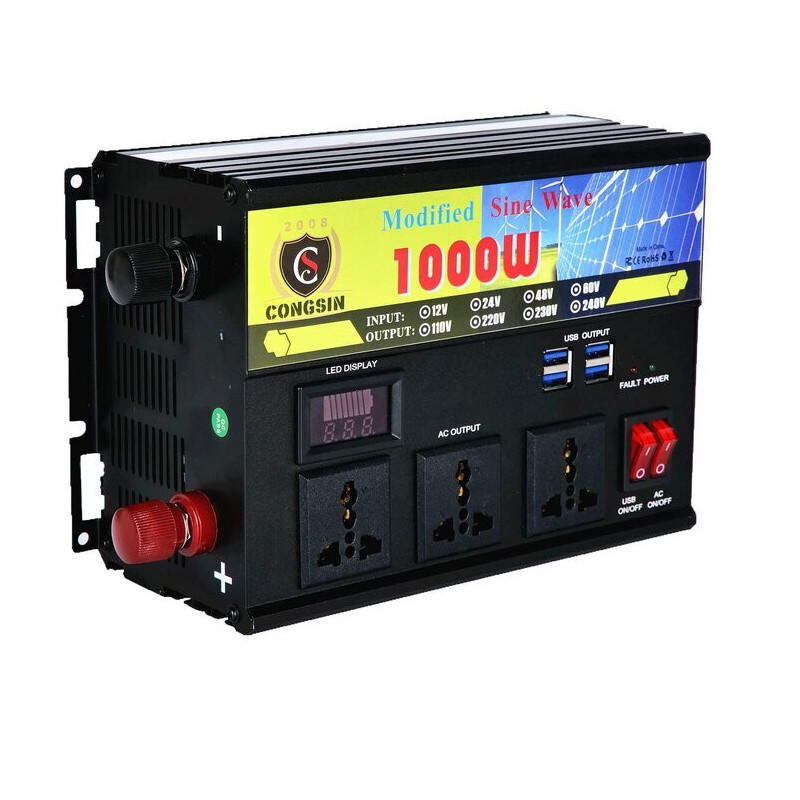
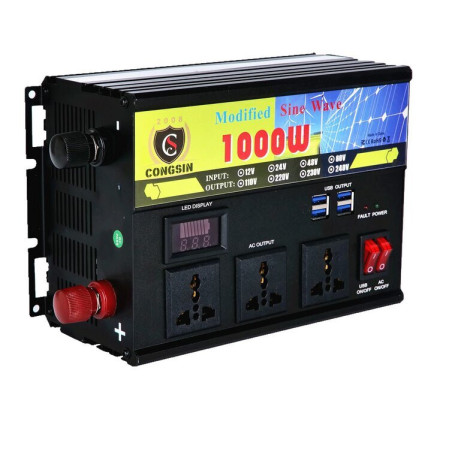
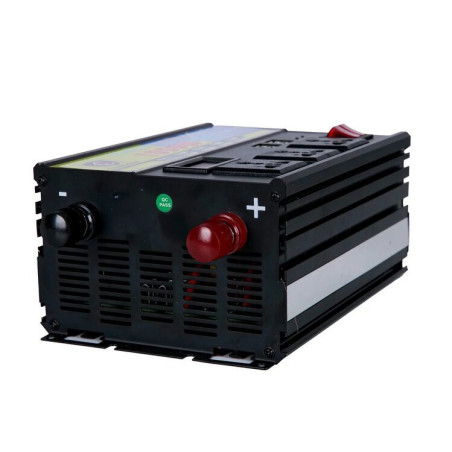


Best value for money!
Best value for money!

A power inverter—or simply an inverter—is a power electronic device or circuit that converts direct current (DC) into alternating current (AC). The frequency of the resulting AC depends on the specific device being used. Inverters operate in the opposite manner to rectifiers, which—historically, in their original large electromechanical form—converted alternating current into direct current.
The input voltage, output voltage, frequency, and overall power management depend on the design of the specific device or circuit. An inverter does not generate power itself; the power is supplied by a DC source.
A power inverter can be entirely electronic, or it may consist of a combination of mechanical components (such as a rotating machine) and electronic circuitry. Static inverters do not utilize any moving parts during the conversion process.
Power inverters are primarily used in electrical power systems involving high currents and voltages. Circuits that perform a similar function for electronic signals—where currents and voltages are typically very low—are known as oscillators. Circuits that perform the reverse function, converting alternating current into direct current, are called rectifiers. Maximum continuous power: 1000 W
Peak load power: 2000 W
Input voltage: DC 12 V / 24 V
Output voltage: AC 110 V / 220 V / 230 V / 240 V
Output waveform: Modified sine wave
Output frequency range: 50/60 ± 3 Hz
No-load current draw: < 0.3 A
Maximum external temperature: < 65°C
Maximum energy efficiency: > 90%
High-voltage cutoff level: 14.5 V – 15.5 V
Low-voltage alarm level: DC 10.4–11 V / 20–21 V
Low-voltage cutoff level: DC 9.7 V – 10.3 V / 19.4–20 V
Ambient operating temperature range: 0–40°C
Protection functions: Low voltage, high voltage, overload, short-circuit protection
Product dimensions: 220 × 160 × 105 mm
Gross weight: 2.5 kg
Specific References
No customer reviews for the moment.